
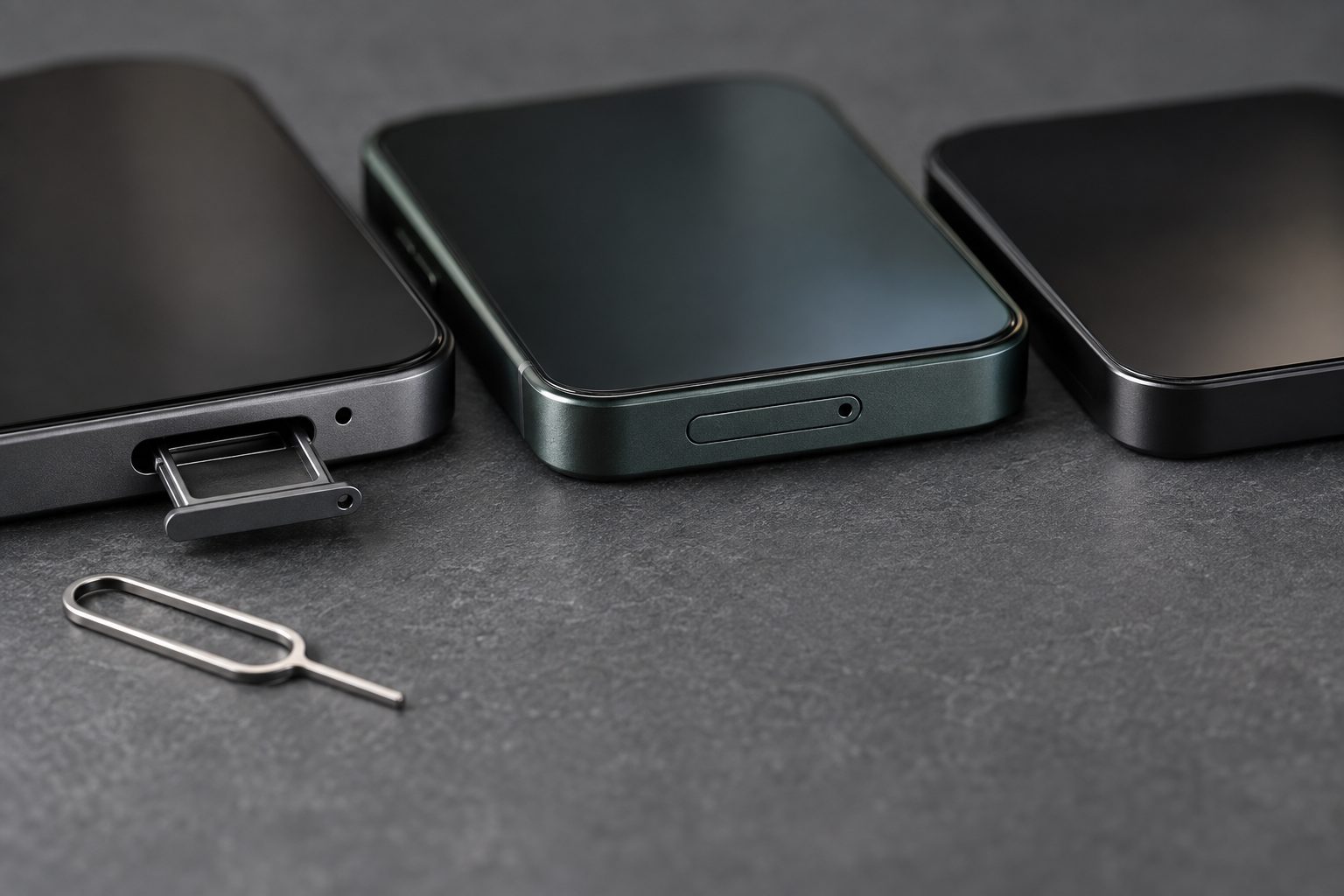
A "Chinese", "US" or "European" iPhone can be a regional variant with differences in SIM and bands. Before buying it for Colombia, check the A#### model number, compatibility with your carrier and whether its IMEI needs registration. If you bring a phone from abroad as a traveller or by post, you register it with your carrier, and an unregistered IMEI gets an SMS and 20 calendar days before it is blocked. The iPhone 14, 15 and 16 sold in the United States have no SIM tray and accept only eSIM. Some Android phones meant for the Chinese market may come without Google services.
How to tell which region an iPhone is from
Go to Settings > General > About > Model Number. The screen shows the part number first, and tapping it shows the A#### model number, which Apple uses to tell hardware variants apart. Compare both with the box label. On an iPhone 8 or later with a SIM tray, Apple says the model number is also in the tray slot. We found no Apple list saying which market each part number belongs to, so ask the seller which market the device was made for and get it in writing.
Knowing the region does not tell you the device is original. That is in how to tell if a phone is original or fake.
US iPhone, eSIM only
According to Apple's SIM type page, these models are eSIM only, with no physical tray.
- iPhone 14, 15 and 16 (including Plus, Pro, Pro Max and 16e) bought in the United States.
- iPhone 17, 17e, Air, 17 Pro and 17 Pro Max bought in the United States, the US Virgin Islands, Canada and some other markets.
Colombia is not among the markets Apple lists for those models. For other variants, Apple lists eSIM and nano-SIM. A refurbished US iPhone with no tray is not defective or a clone, but it needs a carrier to activate an eSIM for you. We did not check which Colombian carriers activate eSIM, on what terms or at what price, so ask yours before buying an eSIM-only iPhone.
Locked to a carrier
A listing that says "locked" describes a device that accepts the SIM of only one carrier. We found no Colombian source explaining how to ask a carrier for an unlock, or what happens to a phone that still owes money to its original carrier. To test it, insert an active SIM from another carrier and confirm it registers on the network and can call.
A phone bought abroad: registration
A phone that a person brings from abroad as a traveller or by postal shipment, is registered by the user with the carrier that provides their service, with the purchase invoice from abroad or with a sworn declaration of sole user and owner. According to the CRC, the procedure is free. If the IMEI is not registered, the carrier sends an SMS and the user has 20 calendar days to register it before it goes to the negative database. Carriers must show a "Registre su equipo" option on their website. In the rule we read we found no deadline for a traveller and no extra fee. The detail is in how to check an IMEI.
Android with a Chinese ROM
For an Android device made for another market, check the installed Google services on the device and the band support of its exact model number. We found no general manufacturer rule that lets us assign those features to every device from one country.
Samsung, Snapdragon or Exynos
The processor can vary by model number and market. Check Samsung's official specifications for the exact model number before buying; we did not verify which variant each Colombian shop receives.
The bands that matter in Colombia
We found no Colombian rule fixing which bands a device must support, and no official table of bands by carrier. What follows comes from the MinTIC spectrum assignments and Claro's terms.
- Claro. 4G at 2500 MHz (band 7) and 700 MHz (band 28). Its own terms ask for an LTE device on band 7 or 2500 MHz for 4G speed. It won a 5G block at 3.5 GHz (n78).
- Movistar. 4G on AWS (band 4) and a 5G block at 3.5 GHz shared with Tigo.
- Tigo. 4G on AWS (band 4) and 700 MHz (band 28), plus the 5G block shared with Movistar.
- WOM. 700 MHz and 2500 MHz assigned to Partners in 2020, which the press identifies with WOM, and a 5G block at 3.5 GHz.
For Movistar, Tigo and WOM we did not confirm that 5G service is live, and for Claro we could only confirm that its terms mention 5G coverage zones. With no official table by carrier, the safe test is to try your SIM in the device before the withdrawal period closes and to ask your carrier which bands your plan needs.
Homologation
Homologation is the procedure through which the CRC seeks to make sure phones entering the country meet minimum technical standards, and it is per brand and model. The CRC says in its FAQ that not every imported device necessarily has to be homologated, only one that has not been homologated and uses the voice network. It publishes an interactive list of homologated equipment, organised by brand and model (bit.ly/ETMHomologados), which we did not open from here. We did not confirm whether a non-homologated device is blocked for that reason alone, or how the CRC treats a refurbished model from another market that is not on the list.
Before paying
- Ask for the full model number and compare it with the box and with Settings.
- If it is an iPhone 14 or later from the United States, confirm with your carrier that it will activate an eSIM for you.
- If it says "locked" or "one carrier only", ask whether it is paid off and which carrier locks it, and do not expect an unlock without proof.
- If the device comes from abroad, ask the seller whether it is already registered. If you brought it as a traveller or by post, ask your carrier to register it.
- If it is an Android from another market, check which Google services are installed.
- Check whether the IMEI is reported on imeicolombia.com.co.
Sources
- Apple, SIM card type of iPhone or iPad
- Apple, the iPhone model number
- CRC, frequently asked questions (IMEI registration)
- CRC, frequently asked questions (homologation)
- CRC, Resolution 5050 of 2016, compilation
- MinTIC, 5G auction result
- Samsung, phones in Colombia
- Claro, data-only plan terms
The Apple pages were read on 1 October 2026. MinTIC spectrum assignments are not a table of bands by carrier, and the band numbers are those that correspond to those frequencies in the 3GPP standard.